


Options trading is a popular strategy in financial markets that allows traders to speculate on price movements or manage risk without directly owning the underlying asset.
While it offers flexibility, it also introduces complexity. Understanding how options work is essential before getting started.
What Is Options Trading
Options trading involves contracts that give you the right—but not the obligation—to buy or sell an asset at a specific price before a certain date.
There are two main types:
- Call options give the right to buy
- Put options give the right to sell
Each contract is tied to an underlying asset such as a stock or index.
How Options Trading Works
An options contract includes several key components.
Strike price
The price at which the asset can be bought or sold.
Expiration date
The date the option contract becomes invalid.
Premium
The price paid to purchase the option.
Basic payoff concept
Payoff = \max(0, S – K)
This simplified formula represents how a call option gains value when the market price exceeds the strike price.
Types of Options Strategies
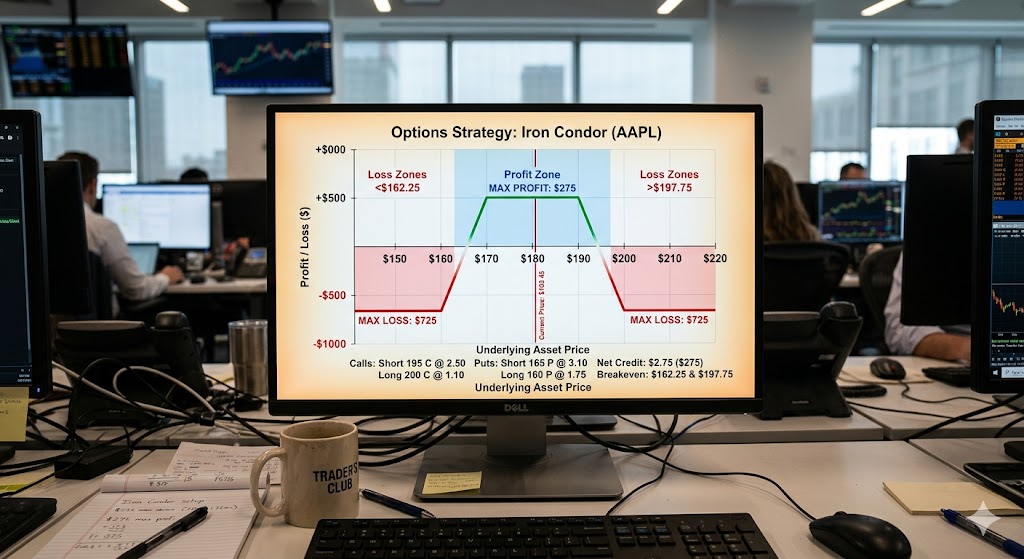
Options trading includes a range of strategies.
Buying calls
Used when expecting prices to rise.
Buying puts
Used when expecting prices to fall.
Covered calls
Generate income from owned assets.
Protective puts
Help limit downside risk.
Each strategy has a different risk and reward profile.
Options vs Stock Trading
| Feature | Options Trading | Stock Trading |
|---|---|---|
| Ownership | No direct ownership | Direct ownership |
| Time limit | Yes (expiration) | No expiration |
| Risk level | Can be higher | Generally lower |
| Flexibility | High | Moderate |
Options add flexibility but also complexity compared to traditional stock trading.
Pro Insight
Options are often used not just for speculation but for risk management. Many investors use them to hedge existing positions rather than to take large directional bets.
Risks of Options Trading
Options trading comes with unique risks.
Time decay
Options lose value as expiration approaches.
Complexity
Strategies can be difficult to understand.
Leverage risk
Small price changes can lead to large gains or losses.
Expiration risk
Options can expire worthless.
Understanding these risks is critical before trading.
Quick Tip
Start with simple strategies like buying calls or puts before exploring more advanced combinations.
Real-World Micro Scenario
A trader expects a stock to rise but wants to limit risk. Instead of buying the stock outright, they purchase a call option.
If the stock increases, they benefit. If not, their loss is limited to the premium paid.
This controlled risk is one reason options are widely used.
Common Mistakes to Avoid
Options trading requires careful planning.
Ignoring time decay
Holding too long can reduce value.
Overcomplicating strategies
Simple approaches are often more effective for beginners.
Not understanding the contract
Details like strike price and expiration matter.
Overleveraging
Using too much capital can increase risk.

Frequently Asked Questions
What is options trading in simple terms?
It involves buying contracts that give the right to buy or sell an asset at a specific price.
Is options trading risky?
Yes, it can be risky due to leverage and time limits.
Do I need a lot of money to trade options?
Some strategies require less capital than buying stocks, but risk management is important.
What is the difference between calls and puts?
Calls benefit from rising prices, while puts benefit from falling prices.
Can beginners trade options?
Yes, but it’s important to start with basic strategies and understand the risks.
Conclusion
Options trading offers flexibility and a range of strategies for both speculation and risk management. However, it requires a solid understanding of how contracts work and the risks involved.
By starting with simple strategies and focusing on risk control, traders can explore options more confidently and responsibly.
Trusted U.S. Resources
https://www.investor.gov
https://www.sec.gov
https://www.finra.org
https://www.cftc.gov
This article is for general informational purposes only and does not provide legal, financial, medical, or professional advice. Policies, rates, and regulations may change over time.